
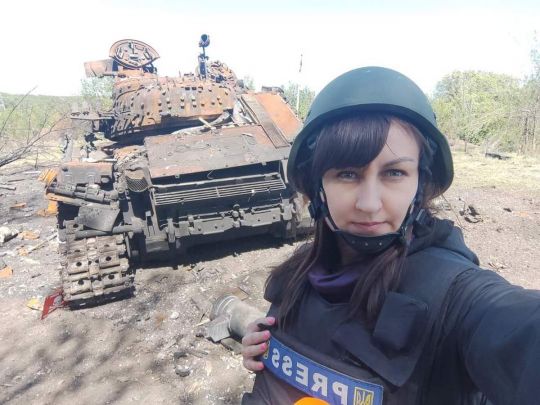

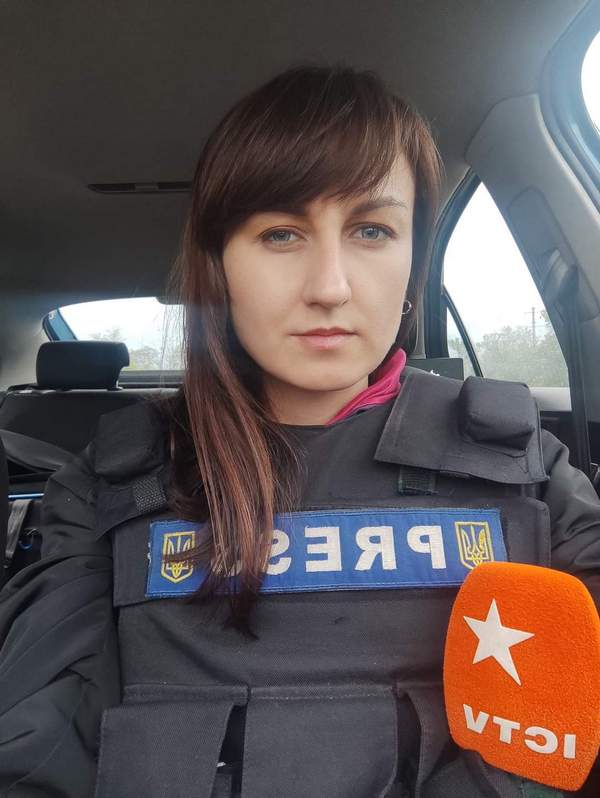
Military correspondent for Facts (ICTV) and the United News marathon Tatyana Nakonechnaya She still reproaches herself for not being at the front from the very beginning of the war, in 2014. But I am sure that it will shoot our Victory! She met Russia’s large-scale invasion of Ukraine at the front. For ten months the war was in its hottest places. Tatyana admits that she is scared, but every time she draws the optimism of our military at the forefront.
In an exclusive interview with FACTS, Tatyana spoke about her most terrible shelling, her shocking history and the mood of the military fighting near Bakhmut.
“I will never forget the rocket attack that we came under in Soledar”
- This time we were no longer able to drive directly to the positions of our infantry near Bakhmut, since continuous assaults continued there.- says Tatyana. - Filmed in the city. Compared to the end of September, when we were last there, Bakhmut is now completely broken. All that was left of him was a skeleton. Bangs non-stop. If earlier there were hours of calm, now the fighting is so intense that they can be heard even in neighboring Konstantinovka. It is 20 kilometers from Bakhmut. In addition, it regularly “arrives” in the residential areas of Bakhmut.
- Did any of the locals stay there?
- Of course, they are becoming less and less, but they remain. For different reasons. Someone does not know where to go, someone does not want to leave their apartment - they cling to the walls, even if they have already fallen in the neighboring house. There are also so-called “waiters” - those who are waiting for the “Russian world”, not realizing that they simply physically can not wait for it - they will die from a Russian shell. The enemy doesn’t care who to kill.
This time I did not want to stay in Bakhmut for a long time. Tried to remove the material as soon as possible. Because I understood that it could fly at any moment. And this is a little distracting even from front-line work - you are always looking for some kind of shelter with your “left eye”.
– Are you afraid?
- Undoubtedly. And I do not believe those who say that they are not afraid. Unless to our military… But they are afraid. They just try not to show it. You know, until February 24, while filming at the front, I was more worried about organizational issues: so that the car would not get stuck in the middle of the field, so that the fighters were in the mood, so that good material would turn out. Before the full-scale invasion, there was a period of so-called trench or positional warfare, when it was still necessary to contrive to catch the arrivals of mines in the frame. Colleagues will understand. Even when we came under shelling, we understood that they would end soon. There was a conditional division into safe and dangerous zones. Now there is no such thing. You may not even reach the forward positions and get under fire on the way. The worst thing is when the “Grad” starts to work and covers with “squares”. A cassette is 40 shells. Jumping fast is not an option. But the main thing is that this fear does not fetter you.
- And what are you doing for this?
- Recently I realized that I had a superstition: before leaving for the front, put on specific berets or not forget your favorite bracelet. Not that I believed it would protect. But at least such things are distracting and somewhat soothing. We try to be as accurate as possible, but this is war. As, probably, I will never forget the rocket fire that we came under in Soledar.
- What happened?
“We had already finished filming and were about to leave when there were explosions. They were getting closer. And at some point, the operator shouted out the colloquial version of the “Air” command, which is always “baked” on the air. All fell. The rocket fell very close. The operator then said that it was a projectile on a parachute, he noticed it in the sky. I was standing with my back, so I did not have time to see. This all happened in a matter of seconds. We are lying. Bahkat. Around only bushes and a field. There is no shelter. But it still wouldn’t save us very much, all of a sudden. And so we were just lucky. I remember that between these explosions I lay and thought: “Interestingly, the operator managed to film it?” If we get out of here, it will be a shame not to show the viewer such everyday life of our military. A colleague already in Kyiv said: “You breathed so evenly and did not even swear on the video.”
I really don’t know why I didn’t say anything at the time. Maybe from stress. But when I looked through this fragment in the recording, I realized that not a single frame and text would convey all the sharpness of our emotions in those moments.
.JPG "В день страшного обстрілу з Назаром Ільницьким - колишнім пресофіцером 24-ї окремої механізованої бригади імені Короля Данила")
Read on Censor.NET: “The Russians have not even shown everything they are really capable of,” Roman Kostenko
“It’s scary, but if necessary, we’ll go ahead”
- What is the mood of the military in Bakhmut now?
We should learn from them optimism. I don’t know where they get it. When I listen to them, I think: “Yes, what problems can I have?” I don’t want to devalue myself, but what they are going through… Guys don’t like to complain. They just say, “It’s hard.” There is no doubt about the victory. You know, before the words “fighting spirit” were perceived as something pretentious. Now yesterday’s pathos does not live up to reality. When I return from the front, for another two weeks I walk in an elevated state.
- I know that a couple of days before the large-scale invasion, you went on a business trip to the front.
- Yes. We met a war within a war. It was a planned trip. I understood that there would be an aggravation, but I underestimated the scale. On Sunday, February 20, we entered Konstantinovka and started working on Monday. There were four direct “inclusions” in the news a day - a very tight schedule. Interest in the advanced increased sharply. It’s already getting hotter there. I remember by Wednesday I was very exhausted. And now the editor of the morning broadcast writes to me that on Thursday I can “not turn on”. Before that, I hardly slept at night. I monitored the news, read the military chat. And on Wednesday, it finally turned off. And almost slept through the war. Then I realized that the phone was dead and the alarm did not ring. I woke up at 6:30 from sleep. I started charging my phone and saw a bunch of missed calls - I hadn’t heard the news yet. I called my mother (my parents live in Brovary), she said that they had already heard explosions. Well, everything turned around. We went to shoot in Shchastya, but we couldn’t go to the city itself. Luckily, the rocket artillery had been working for several days. And that morning they just leveled it with the ground. The city was about three kilometers away. I asked the film crew what we were going to do. I was struck by the driver’s answer: “It’s scary, but if necessary, we’ll go ahead.” I decided to turn around. On the way, I thought about what to do next or stay in the Donetsk region. The fighting in the Kharkiv region has already continued. Our usual road became impassable. I wrote to the graduation editor, he said that we should go to Kyiv. We got out through the Dnieper for almost a day. On the way, they still made the “switching on”. And my relatives in Brovary just went crazy.
Did your parents leave Brovary?
- Mom and her sister left for their native village a few weeks later, but my father stayed. He didn’t even want to hear about the evacuation. I immediately began to get nervous: “I’m not going anywhere! Let them get out of our land!”
- Many television people in the first months of the war lived right on the canals.
- And me too. Along with my two cats. When I returned from the front on February 25, the man was not at home - he was called to work, the cats were sitting at home hungry. We already heard a knock in Vyshneve. It was a strange feeling. The house has ceased to be associated with security. I bought at the grocery store and slept for several hours. Until March 10, I still went to work, but there was already a problem with transport. Plus a curfew. And the schedule no longer allowed to go back and forth. In the morning you shoot, in the afternoon you unsubscribe the plot, at night you broadcast. It also became clear that the man would not be able to come home and feed the cats. And I decided to settle with them on the channel. I lived in the room where the stories were edited. There was an air mattress, then moved to the sofa. The shower was at work, the food too.
It was very difficult when we went to shoot in the fired Bucha, Irpin, Borodyanka. It was so hard emotionally that when we returned to the channel, my colleague and I simply did not talk. They were silent for hours. It felt like a stone block inside. I just fell on the sofa and the cats came running, purred and fell asleep on me. So little by little it became easier for me. In fact, I lived on the channel for almost three months.
- During these almost ten months of a full-scale war, was there a story that you still remember?
- Yes, about the boy Elisha from Brovary, who was killed by the Russians when he tried to evacuate from the village of Pobeda, Baryshevsky district, with his mother and younger brother. They left Brovary for this village, looking for a quiet place, but ended up in occupation, having experienced a real hell. When they decided to get out, the Russians gave them an unofficial corridor. Mother recalled that they even waved after the car. And then… they shot her. Elisha was in a white T-shirt and a red hat, sitting in the back seat of the car. When the shelling began, the mother fell out of the car along with her youngest son, whom she simply pulled by the hood, and Elisha let out of sight. He was older, and she hoped that he could jump out on his own. When the shelling ended, she ran to the car, opened the door and saw that Yelisei had simply curled up in the seat. I saw a photograph of his hat… there was a sieve left. I asked Elisha’s mother where she finds the strength to speak to journalists. She replied that she simply did not want the story to be forgotten.
See also: “Rashists did not allow to carry away the body”: a 13-year-old boy who died in front of his mother will be reburied in Brovary
- What will we do with the Russians when we win?
- As my close person says: “We kill them.” But I want Russia to disappear in the literal sense of the word. To make the word “Russian” so toxic that they are ashamed of their nationality. That will be our victory. You know, I reproached myself for not having started working in the war since 2014. I didn’t film the beginning, but I want to film the end of this war!
The Reporters at War project was created with the participation of CFI, the French media development agency, within the framework of the Hub Bucharest project with the support of the French Ministry of Foreign Affairs.
See also: “We must not lie to ourselves about the price we will pay for the Victory,” General Sergei Krivonos
In the photo in the header Tatyana Nakonechnaya in Belogorivka, Lugansk region
Source: Fakty