
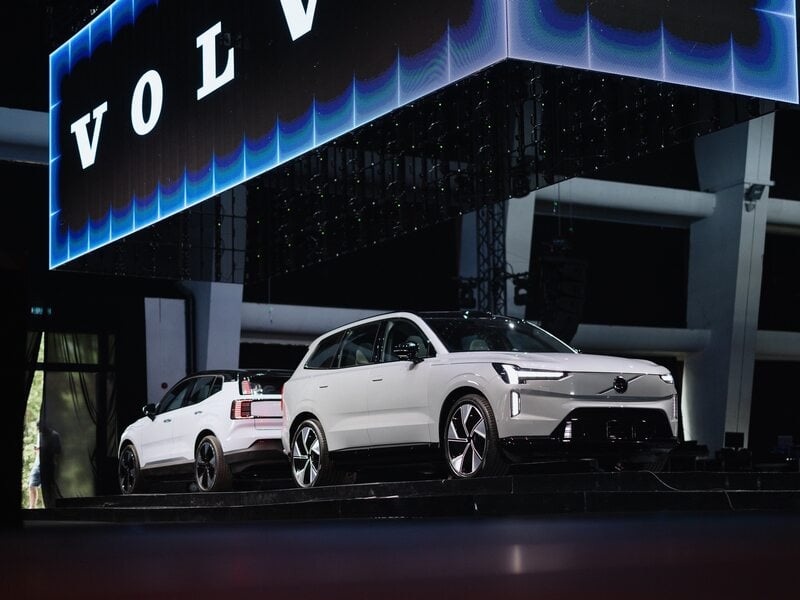
The smallest electric Volvo, with a design that defines the future of the Swedish brand, has made its debut in Poland. Finally we saw the car live. And finally, we were able to assess its market potential. And compare with the biggest EX90 that is already driving on Polish roads.
No car has had such a grand debut for a long time as the new EX30 crossover. First the car was seen by journalists, and then it was watched by customers and invited guests at an event that brought together several thousand people at the Warsaw Hippodrome in Służewiec.
It is no coincidence that the EX30 was put on the main stage in the company of the flagship electric Volvo, that is, the EX90, which also celebrated its official debut (although already driving on Polish roads). These two cars have a lot in common. The EX30 is to become a symbol of the future of the Swedish marque, an affordable car and the best-selling Volvo in Poland and Europe (with electric drive). In turn, the large SUV EX90 is a prestigious car, big, bristling with technological innovations: in a word, showing what the Swedes are capable of.
Long awaited breakthrough
Let’s focus on the smaller cars: the new ones. Admittedly, the EX30 looks fantastic. The car is Scandinavian minimalist, but by no means boring. Against. The Swedes decided to give the electric crossover as much greed as possible. Perhaps because the electric baby Volvo EX30 can be ordered with top-wheel drive, making the car a real road racer.
The EX30 is the newest and smallest model in the Volvo range, with its world premiere in June 2023. It differs from the larger models of the brand with a completely new style. It is based on a different floor slab (SEA). Ultimately - the Volvo EX30 is the model that the Swedes believe in in terms of volume. The company wants to increase its sales because electrification in Europe has begun to accelerate.
The Volvo EX30 has several exterior features that bring it closer to the brand’s larger models. For example, headlights with the characteristic Thor’s hammer motif, or vertical taillights, but much bolder. The latter form separate sections and are connected by horizontal light stripes.
Does the EX30 open a new chapter in the design of the Swedish brand? Everything seems to point to it. He does not radically break with the old style, because we are talking about Volvo, but at the same time he is clearly starting a new one. Consider the dimensions: the length of 423 cm is 19 cm less than the XC40 model. The EX30 is 4cm shorter than the discontinued V40. It is the shortest model in the Volvo lineup since the end of C30 production.
There must be a crossover
The EX30 is an electric crossover, i.e. a small SUV. The way the roofline is laid out, as well as the rounded and smooth surfaces of the body, clearly indicate that the designers sought to reduce aerodynamic drag, achieving a Cx result of 0.28. The EX30 can be ordered with 18″, 19″ or 20″ wheels. All models are aerodynamic.
Volvo smiles at the youth, whom it sees as unequivocal allies of electromobility. Since the EX30 was created for younger customers, along with classic colors such as black, white or grey, the offer includes bright and bold body colors. The first is Cloud Blue, a bright metallic blue with a contrasting black roof. Another suggestion is yellow moss. It is yellow with hints of green. It also matches with the black roof.
What’s new in the salon
Volvo Cars has phased out animal skin upholstery for its electric models. So we won’t find them in the EX30. However, there are many textile upholstery. Two are obvious: black and light - that’s obvious. But the Breeze upholstery is brand new. It’s light blue. Dark green pine upholstery. Indigo upholstery - denim in color and texture - has great potential to become a favorite option for future customers, according to Volvo Cars.
The inside handle of the driver’s and front passenger’s doors looks like a continuation of the silver trim strip. The front doors have spacious niches with illumination. Interestingly, there are no speakers in the doors at all. This allowed them more space for small items. The speakers were in front of the driver. It’s a Harman Kardon idea, and its design is reminiscent of a soundbar. Spatial sound is provided by an algorithm that controls the sound and its delays.
In the Volvo EX30, the steering wheel is slightly flattened. The choice of driving modes (forward or backward) is carried out by a lever mounted on its rack. The lack of a drive mode selector in the center tunnel freed up space that was filled with multiple storage compartments. There is a recess in which two large smartphones can fit side by side. One of them can be charged inductively. There is also a movable armrest. The boot floor folds down to increase its depth.
Is the center screen different too? Volvo has been getting used to touchscreens for years instead of lots of physical buttons. Therefore, the EX30 also has such a screen (diagonal 12.3 inches). What’s new is that there is no traditional instrument cluster directly in front of the driver. Vehicle speed, battery level and all other information are displayed on the central screen above the central tunnel. The only screen in the cabin.
Mechanics and performance
Let’s move on to, perhaps not the most important, but certainly very important: performance. Feels like a premium segment. On electric vehicles, top-end varieties can boast acceleration to hundreds in less than 6 seconds. In the Volvo EX30, this is the performance of the base version. Depending on the version, acceleration from 0 to 100 km / h is 5.7 seconds, 5.3 seconds or 3.6 seconds.
The last staggering value comes from the all-wheel drive version, with two engines producing 428 hp. (543 Nm). Rear-wheel drive versions have a power of 272 hp. (343 Nm). The battery capacity is 51 kWh or 69 kWh. The smaller one is only available with rear-wheel drive. WLTP range: 344 km (51 kWh battery), 480 km (69 kWh battery, rear-wheel drive), 460 km (69 kWh all-wheel drive version). Top speed is limited to 180 km/h. Most electricians in this class are slower and less dynamic.
Security at a new level
Safety and Volvo are synonymous in the automotive world. The EX30, unlike the EX90, does not have LiDAR. However, it has a set of other security systems. The front of the car has a long-range radar and a camera. There is also a separate wide-angle camera for easy parking and four ultrasonic parking sensors. There are two more radars that monitor the area directly in front of the car, directed to the sides. Each side has one parking chamber and one ultrasonic sensor. The rear is also protected by four sensors, two radars, and they are supported by a camera. In the cabin, safety is provided by driver and passenger detection systems. This whole set called Safe Space consists of 10 ultrasonic sensors, 5 radars, 5 cameras and two sensors in the cockpit. Volvo EX30 will have a system to protect cyclists passing by the car. The sensor system will detect a nearby cyclist or any other vehicle and warn you not to open the door at the most inopportune moment.
Polish prices are already known
Hundreds of orders for the EX30 have already been placed in Poland. This is because the price list was announced very quickly, which shocked many. The price of the Volvo EX30 starts from PLN 169,900. For that price, we get the base Core trim, a 51kWh battery, and a 272hp engine driving the rear wheels. The flight range of this version is 344 km (according to WLTP). For PLN 209,900 we get the Plus version with a range of 480 km. The engine also has 272 hp, but the Long Range battery has a capacity of 69 kWh. For less than PLN 239,900, the richest Ultra version is waiting for us in the strongest version with a two-axle drive, with a power of 428 hp. and a power reserve of 460 km. Here the battery also has a capacity of 69 kWh.
There is no doubt that this car will be a success and popularize the electric Volvo. How the EX30 drives, we will write to you shortly.
Volvo EX30 in numbers
-
Dimensions (L x W x H): 4233 x 2032 x 1549 mm. Width with mirrors. For comparison, XC40: 4425 x 2034 x 1658 mm.
-
Wheelbase: 2650mm (XC40 has 19cm longer wheelbase only 5cm)
-
Weight: TBA
-
Trunk capacity: TBA
-
Three trim levels: Core (Safe space technology, heat pump (for LR), 11 kW AC charger; adaptive cruise control), Plus (Harman Kardon audio system, power tailgate, Pilot Assist, Ambient interior lighting, contrast black roof), Ultra (22 kW AC charger, parking assist, panoramic sunroof, power seats, 360 camera).
-
5 exterior colors: Vapor Grey, Onyx Black, Crystal White, Cloud Blue (new), Moss Yellow (new)
-
4 upholstery options: Indigo (a la denim), Pine (green), Breeze (blue), Mist (wool).
-
Aero wheels: 18″ or 19″ and 20″ (optional)
-
Permissible weight of towed trailers: 1000, 1400, 1600 kg. (Single Motor/Single Motor Extended Range, Dual Motor Performance)
-
Engine options: single-engine (rear-wheel drive, 272 hp, 59 kWh, range 344 km WLTP), single-engine long-range (rear-wheel drive, 272 hp, 69 kWh, range 480 km), dual engine performance (four-wheel drive, 428 hp, 69 kWh, range 460 km).
-
Acceleration 0-100 km / h (successively): 5.7, 5.3 and 3.6 seconds.
-
Maximum speed: 180 km/h - for all versions.
Source: Wprost

I am Jason Root. I work in the news website industry and mostly cover the automobile industry. I have also written for Daily News Hack. My work revolves around new car models, prices, and features. In addition, I often write about used cars and tips for buying them. My articles are meant to be helpful for those who are in the market for a new or used car.