
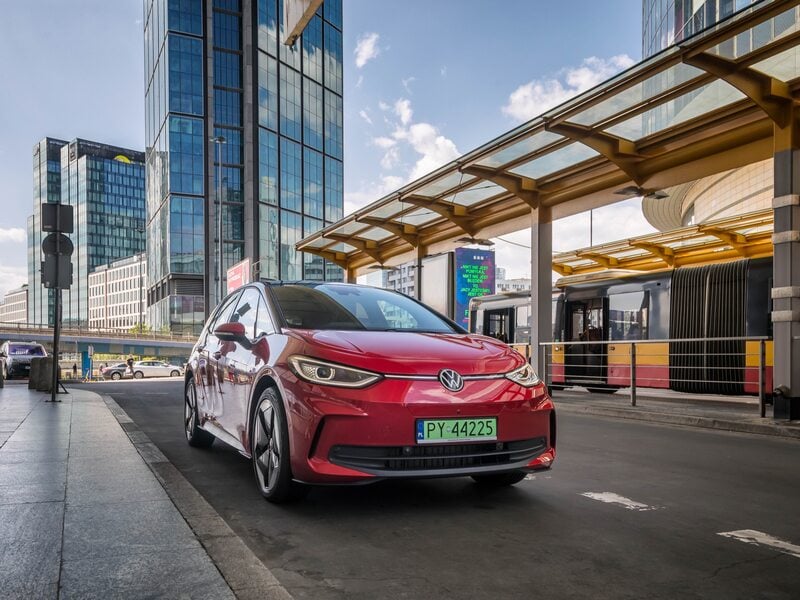
Volkswagen literally means “people’s car”. If so, he should listen to his clients. And the company does it, the best proof of which is the new generation (or, as some say, the facelift version) of the most popular ID.3 electric car.
The ID.3 was introduced in 2019 and released in 2020, still in the midst of a pandemic. Orders rained down, but also words of criticism. First of all, on materials, too low quality and design. It was argued that the car lacked character.
So, after 3 years, it’s time for a change. And Volkswagen - a rarity among car concerns - admitted that while the car is generally not bad, some things need to be improved. And it just so happens that exactly what customers were complaining about was improved. The biggest changes in relation to the new version concern the design, which has definitely been refined. Secondly, much better software was used. And thirdly: the materials are of much better quality, more pleasant both to the eye and to the touch. The result is a much better car that we were able to test during the first test drives in Poland.
Changed at first sight…
The ID.3 now has a more aggressive look. The new front design makes the model more dynamic than before. Body lines are clearer. The interior of the ID.3 is of higher quality, which is noticeable immediately after you get into the car. Better materials have been used and functionality has been improved. There are no materials of animal origin in the interior, but a lot of recycled materials.
… and on the other
According to the brand tradition, solutions and systems from more expensive cars have been added to ID.3. Therefore, the model is equipped with Travel Assist, which allows you to drive a car with a high degree of automation. It also has Parking Assist Plus with memory function, which allows you to automatically save and recall saved parking maneuvers, for example in front of a house. Added voice control function and head-up display with augmented reality.
The new Volkswagen ID.3 is equipped with the latest software for performance enhancements and remote (over the air) updates. Software for identification. offers features that can be activated later. Volkswagen allows customers the flexibility to respond to their needs and use services and features as needed. Examples include the navigation system and dual-zone automatic climate control, which electronically regulates air temperature, air flow and air distribution. Standard features such as electric vehicle route planning, Plug & Charge at fast charging stations or at home, or bi-directional charging (BiDi-ready) help with everyday city driving as well as long journeys.
The new ID.3 is 4.26 meters long, 1.81 meters wide and 1.56 meters high. Like its predecessor, the second generation ID.3 features a long wheelbase and short overhangs. A new lacquer Dark Olivine Green has appeared in the color scheme. It is an iridescent color with a warm golden pearl effect. The roof is black, which contrasts with the rest of the body. Roof molding matt silver.
The barrel of the upgraded ID. 3 has a capacity of 385 liters, and with the rear seat folded down, its capacity increases to 1267 liters (when loaded to the roof). As an option there is a hook for attaching a bike rack with a maximum load of 75 kg.
New lights
In the case of modern cars, lighting is crucial. And here Volkswagen also tried. All trim levels use LED technology as the light source. IQ.Light matrix headlights will be available at an additional cost. When the driver approaches the car with the key, the car seems to wake up and open its eyes - this impression is due to the fact that the headlight modules rotate around a vertical axis. Combined with the optional keyless entry system, the car “tryes to make eye contact” with the driver by turning its eyes in one direction or another. At the end of the driver salute sequence, the exterior mirrors project a special ID sign onto the ground.
The new ID.3 comes standard with automatic high beam control. The optional IQ.Light LED matrix headlights always illuminate the road as brightly as possible without dazzling other road users. Each headlight module consists of 18 LEDs, eleven of which can be individually switched off and dimmed. The lighting package is complemented by a light strip between the headlights. When the light is on, the headlights are almost connected, and the Volkswagen badge is in the gap. Each of the rear lights has nine flat light guides that form arc-shaped lights with a particularly intense red color. The brake lights form an X-shape, while the dynamic indicators extend from the center outwards. On vehicles equipped with matrix LED headlights, animated light patterns also appear in the rear lights.
204 hp engine
What drives the new ID.3? The electric motor is located on the rear axle and develops 150 kW (204 hp) and 310 Nm of torque. Thanks to the rear-wheel drive, the car is very agile with a turning radius of 10.3 m. The electric motor is located above the rear axle and transmits its torque to a two-speed single-speed gearbox with differential. The new ID.3 Pro accelerates from 0 to 100 km/h in 7.3 seconds and has a top speed of 160 km/h.
Two battery versions
The new ID.3 will be produced in two versions, differing in battery capacity: it can be 58 or 77 kWh. The 77 kWh battery gives the ID.3 Pro S a range of up to 546 kilometers (WLTP). With a 58 kWh battery, the ID.3 Pro has a range of up to 426 kilometers (according to WLTP).
At the fast charging station, the ID.3 Pro S battery can be charged from 5 to 80 percent in 30 minutes with a charging power of up to 170 kW. The ID.3 Pro takes 35 minutes to charge up to 120kW.
Source: Wprost

I am Jason Root. I work in the news website industry and mostly cover the automobile industry. I have also written for Daily News Hack. My work revolves around new car models, prices, and features. In addition, I often write about used cars and tips for buying them. My articles are meant to be helpful for those who are in the market for a new or used car.