
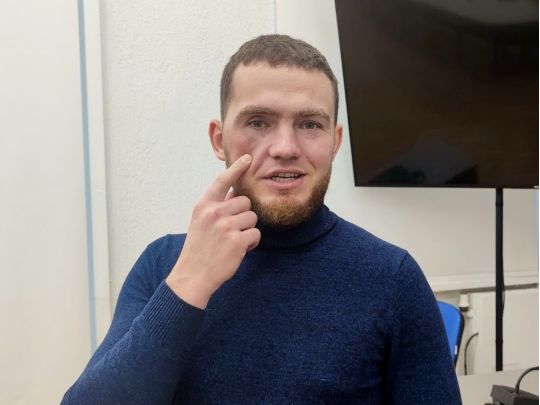

“When a bullet hit me under my right eye, I instantly lost consciousness, I was in a deep coma for 11 days,” Vladimir Tovkis, a veteran of the Russian-Ukrainian war, told FACTS. - The first thing I felt when I woke up was surprise: I remembered that I was with my brothers in the trenches in the Donbass, I suddenly open my eyes and see a hospital ward. “How did I get here?” It was impossible to ask this out loud. The problem was not only with speech - at that time I could not only walk, I could not even move.
“The guys pulled me out of the trench wounded and carried me as soon as possible across open areas, risking my own life”
- I remember that the head physician of the Dnipropetrovsk Regional Hospital named after Mechnikov Sergey Ryzhenko came up to my bed, clearly speaking so loudly: “Volodya, can you hear us (my mother and wife were standing next to him)? Blink your left eye.” I blinked. At first, I had to communicate in this way - with the help of blinking my eyes: once I blink, it means “yes”. Twice - no.
Under what circumstances were you injured?
This happened on the night of September 25, 2019. Our unit was in new positions, which the guys from “Azov” won back from the enemy. I looked through the night vision device. What happened after that, I don’t remember. Consciousness turned on only after 11 days, when he opened his eyes in a hospital in the Dnieper.
About what happened to me after the wound, I know from the stories of those who saved me - brothers in arms and doctors. To begin with, the night vision device that I was looking at when I was wounded has a small screen. It gives a very faint glow. But in complete darkness, this light can also be seen 100 meters away. An enemy shooter fired at him.
- Did you manage to get you to the doctors without wasting time?
- Yes, the guys acted as quickly as possible and, as the doctors later said, this gave me a chance to save my life. At first the brethren tried to carry me along the trench. But by that time they had not yet had time to dug it up properly (as I already said, these were only new, but won positions), so it was extremely difficult to move me. And every second during the evacuation of a seriously wounded is extremely important. Therefore, the guys pulled me out of the trench and carried me away across the open countryside as soon as possible, risking their own lives. Luckily, the enemy did not see them. We were taken to our old positions, where an evacuation vehicle had the opportunity to drive up. He rather took me to a medical facility in the town of Chasov Yar (Bakhmut district), and from there they took me by helicopter to the Dnieper to the Mechnikov hospital.
- How did the doctors assess your condition?
“To be honest, how awful. I was later told that one of the doctors (either in the Vremenny Yar, or already in the Dnieper), allegedly said: there is no point in taking on this patient. But the doctors did not think to let me die. Here is what the neurosurgeon Alexander Marchenko wrote on Facebook, who, together with his colleague Vadim Botik, performed an operation on me in the Dnieper. “When the ambulance delivered the wounded man to Mechnikov’s hospital, several teams of specialists were waiting for him along with the leadership. Immediately to the emergency room. The condition is extremely difficult. Vova himself did not breathe, his heart almost did not beat, the pressure approached zero, a deep coma, there is no reaction of stars to light. After 30 minutes, the pressure was stabilized, performed by SCT (spiral computed tomography. - Auth.) of the brain. The scale of the defeat was astonishing. The bullet flew under the right eye, crushed the walls of the maxillary sinus, flew through the right hemisphere of the brain, pierced the occipital bone and stopped under the skin. Together with the head of the department, Andrey Grigorievich Sirko, they developed an operation plan. The highly complex neurosurgical operation lasted four and a half hours.” I am eternally grateful to the doctors for saving me.
“For some time my brain was covered only by skin, and I could touch it, feel its convolutions with my fingers”
- What were your thoughts, experiences in the first weeks after the injury?
- For a long time (about two months) there was a feeling that this could not happen to me. After all, I have been in the army for a long time (I served 14 years), I have been well trained, I have considerable combat experience. I did not believe that I could so easily substitute myself under the ball. I thought to myself: well, maybe I could get some kind of injury, but not so severe. I woke up with the thought: this is a dream, now it must end. But gradually I had to accept reality as it is. And how not to accept when the brain at that time was covered only by the skin, and I could touch it, feel its convolutions with my fingers. Then it was covered with a titanium plate.
As for thoughts of suicide, then get rid of their help wife Ekaterina. This was when I was already transferred from the Dnieper for rehabilitation to a Kyiv hospital. I say to Katya: “How exhausted I am from all this, I will jump out of the window.” And she told me calmly like this: Yes, on the grid windows. Yes, even the first floor. Her words affected me so much that after that I didn’t even stutter about suicide. It also helped to realize that people had done so much to save my life (including risking their own) that it would be unfair to them to commit suicide.
How long did it take to recover from an injury?
- Yes. Here is a clear illustration of this: on December 31, 2019 (that is, three months after the injury), Ekaterina and I officially got married. Moreover, thanks to the help of the media, the ceremony was held in the October Palace. There it was necessary to overcome somewhere ten steps. But then it was very hard for me. I clung to Katya and was slowly going up. The guard, who witnessed this, joked: “How many people I work here for the first time I see that the groom was so strongly pulled to marry.”
Before that, Katya and I lived in a civil marriage for a long time. They didn’t find time for the wedding: I was either at the training ground, then on a business trip, then on rotation at the front. And then there was a lot of free time, so we decided to sign. The next 2020 was a very busy year, so we signed on the last day of 2019.
Gradually I recovered from my injury. The support of his wife played a huge role in this. It also helped that I went in for sports - rowing on simulators, as well as discus throwing. Now I train twice a week at the Next Step Ukraine rehabilitation center, organized in Irpin by American benefactors of the Foundation for the Revival of Defenders of Ukraine. The center was created specifically for the rehabilitation of soldiers who were injured at the front. The lessons are free.
Regarding my rehabilitation, one more thing should be said: the right hemisphere of the brain, which the enemy ball pierced me, is responsible for the mobility of the left side of the body, in particular the arm. Many veterans, who, like me, have a right hemisphere of the brain, have, unfortunately, only partially regained the mobility of their left hand. My left hand work has resumed completely. Without the qualified help of rehabilitation doctors, all this would be impossible. Thanks a lot to them.
- What are you doing now?
- After being wounded, I became an invalid of the most severe first group, so I have no right to remain in the army. But I have now been taken as a civilian to the military position of an instructor - I pass on my combat experience to recruits.
“The idea to write a book arose while climbing Hoverla: the four veterans who then went up the mountain had only one leg”
In the afternoon in Kyiv there was a presentation of Anastasia Fedchenko’s book “You won” about 11 wounded veterans of the Russian-Ukrainian war. One of its heroes was Vladimir Tovkis.
- The idea to write this book came to me in 2019 while climbing Hoverla, - the author said at the presentation. - The four veterans who then went to the mountain had only one leg. Instead of other legs - prostheses. But you should have seen how positive these guys were filled, you would have heard how they joked! Let’s say, when we went down after the ascent, they jokingly told people who were just going to go up: “Don’t go there - we lost our legs there.” I have been writing this book for the past year. It had already been prepared for printing when the open invasion of the Russian army into Ukraine began. So the press was delayed. One of the heroes of the book, a reconnaissance officer of the 93rd brigade with the call sign “Sakura” (when we talked with him, he had no eyes and 17 teeth due to a wound) died in May near Izyum. Another hero of the book (also from the 93rd brigade) is either captured or missing.
I must also say that for a long time we could not come up with a title for this book. The name “They won” appeared with the light hand of the Commander-in-Chief of the Armed Forces of Ukraine, General Valeriy Zaluzhny.
Photo courtesy of Vladimir Tovkis
Source: Fakty