
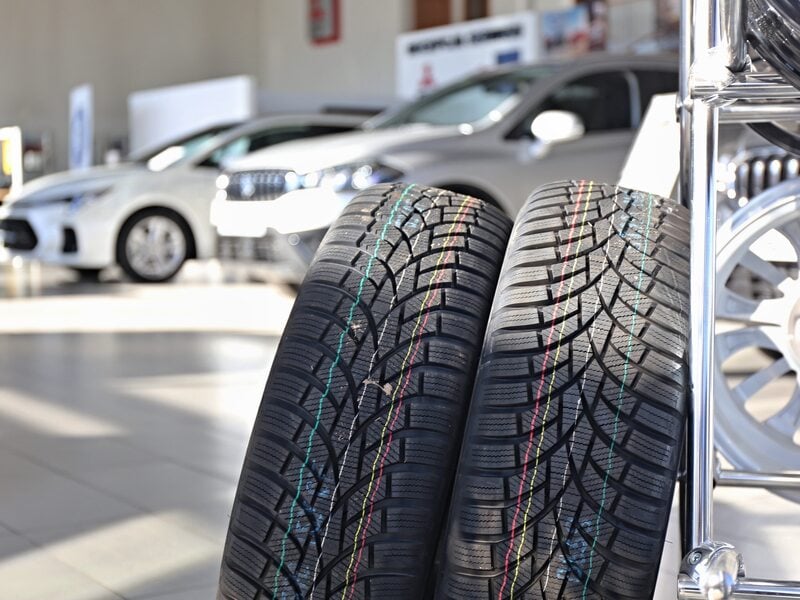
Longer braking distance, greater tread and fuel consumption. In the summer, winter tires are a bad idea. Read the calculations that will convince you to change them.
If the tire shop advised you to buy winter tires in the summer - because they are already running out - then change it to a more professional one. Don’t forget to also change your tires - at the latest before going on holiday. Too soft a winter tire tread compound, even on dry roads, will impair traction and your safety. These are not tires for racing Formula 1 or Le Mans. There, the soft compound is not the same as in your winter tires - it has as much in common with civilian tires as our cars have with racing tires. This is confirmed by the test results carried out by TÜV SÜD.
The idea of saving money by buying summer tires and driving winter tires in the summer may be tempting to some. Unfortunately, we risk this decision every day - winter tires will not be able to provide traction during the summer heat and showers. And in addition, from saving threads - even if we do not lose time, nerves and money after an accident, we still have to buy new tires for the winter. Little will be left of the existing ones, because their tread wears out very quickly. Let me remind you that its minimum depth is not 1.6 mm, as some say. According to the regulations, priority in determining the depth is given to the wear indicator on the tire, which can be at the level of 2 or even 3 mm, depending on the manufacturer. Only when there is no such indication, the minimum depth is 1.6 mm. Let’s remember this, because the police have the right to stop us with a registration document for bad tires.
Technology matters
According to the Polish Tire Industry Association, summer tires have a tread compound hardness adapted to high temperatures - up to 65 degrees Celsius - which the road gets hot on hot days. Winter tires are the opposite. On the other hand, the hardness of the tread compound of all-season tires is intermediate. That is why they are recommended mainly for cars that drive around the city in summer and winter and have a small annual mileage, up to 10,000 km. km. Otherwise, they completely wear out even in 1 year. Their tread is softer than a typical summer tire and wears out faster in such weather.
– Driving on the wrong tires at different times of the year is a sign of inattention and lack of imagination. It is important for drivers to always remember that changing seasonal tires is an expression of concern for them and other road users. Using the right tires improves driving safety, braking performance and skid resistance in rainy weather. Winter tires in the summer mean much longer braking distances and 2.5 times more wear - so nothing will be left of them for the winter. So if someone is thinking about driving with winter tires, it’s not the best idea for their own safety, explains Piotr Sarnecki, CEO of the Polish Tire Industry Association (PZPO).
Tests irrefutable proof
Tests carried out by TÜV SÜD Polska have revealed huge differences in the braking distances of summer and winter tires during the holiday season. Tests carried out at a temperature of only +23 degrees Celsius (when the road surface is heated up to +40 degrees Celsius) have shown that the use of winter tires on dry pavement significantly increases the braking distance. How long is this extra episode? The results of the study show that the difference at a speed of only 85 km / h is 9 meters - more than twice the length of a car or a pedestrian crossing.
- The rubber compound used in winter tires is not effective in such weather as we have outside our windows. Such temperatures are not uncommon on hot days. Tests carried out on dry surfaces confirm how significant differences can be achieved with seasonal tires. Even on wet roads, a car with summer tires will stop faster than with winter tires. Studies by TÜV SÜD and PZPO show that this difference is 8 meters (35 meters for summer tires and 43 meters for winter tires). This is a huge disproportion, given the fact that sometimes literally one meter is not enough to avoid a collision or impact, - notes Piotr Sarnetsky.
Tire life is lower, fuel consumption is higher
It is worth noting that TÜV SÜD in its report recommends mandatory tire changes depending on the season and changing weather conditions. This recommendation is based on a specific analysis of study results. Keep in mind that winter tires, as the name suggests, are designed for driving in cold temperatures. Their grip is better than summer tires, especially at temperatures below 7 degrees Celsius. This is due to the use in the production of a different rubber compound compared to summer tires.
– High summer temperatures lead to overheating of the winter tyre. This, in turn, can cause lateral deformation, cracks or other structural damage, which reduces the life of the rubber by up to 60%. Significant temperatures also cause winter tires to become too soft, which increases rolling resistance and adversely affects fuel consumption. Studies show that, depending on temperature and driving style, fuel consumption on winter tires used in summer can be 20 to 30 percent higher than in winter. more. In addition, winter tires wear out four times faster in summer than their summer counterparts. For this reason, one set of winter tires lasts twice as long, - Piotr Sarnetsky lists.
Source: Wprost

I am Jason Root. I work in the news website industry and mostly cover the automobile industry. I have also written for Daily News Hack. My work revolves around new car models, prices, and features. In addition, I often write about used cars and tips for buying them. My articles are meant to be helpful for those who are in the market for a new or used car.